Sony IMX334: Why Large-Format Lenses are Critical for True 4K Image Quality
When pursuing "True 4K" surveillance or machine vision solutions, many developers focus solely on the pixel count of the sensor model while overlooking the physical constraints of the Lens. As a staple of industrial-grade 4K sensors, the Sony IMX334 features a 1/1.8" large-format sensor, which imposes extremely stringent requirements on lens selection.
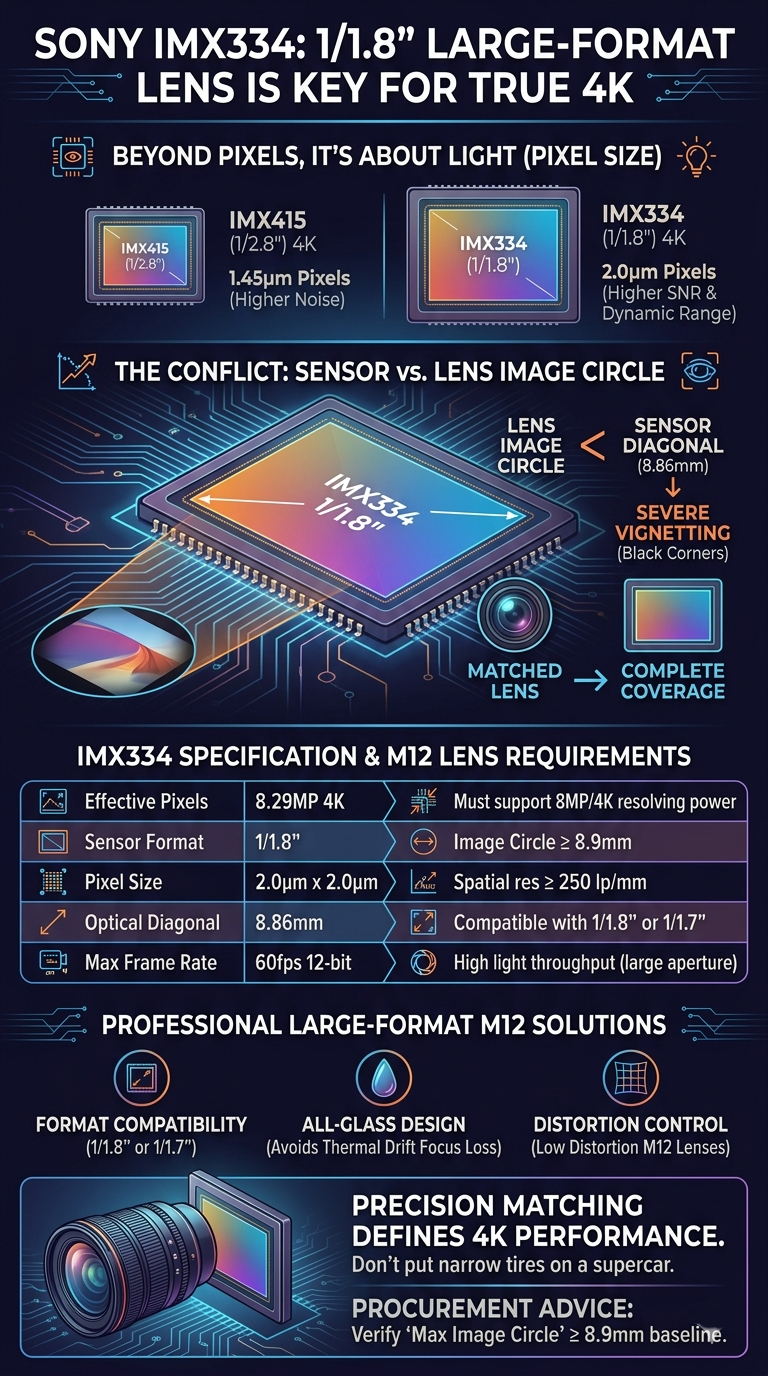
1. The Core Conflict: Pixel Density vs. Image Circle Size
The definition of "True 4K" goes beyond a 3840 * 2160 resolution; it is rooted in the light-gathering quality of each individual pixel.
IMX415 (1/2.8"): Although it provides 4K resolution, its pixel size is only 1.45μm, leading to significant noise in low-light conditions.
IMX334 (1/1.8"): Features larger 2.0μm pixels. This means that under identical lighting, the IMX334 delivers a higher Signal-to-Noise Ratio (SNR) and wider dynamic range.
However, larger pixels necessitate a larger sensor format. Traditional M12 lenses are mostly designed for 1/3" or 1/2.7" sensors. If these lenses are forced onto an IMX334, the light will fail to cover the entire sensor, resulting in severe vignetting and degradation of peripheral image quality.
2. Specification Table: IMX334 Key Metrics & Lens Matching Requirements
To unleash the full potential of the IMX334, an M12 lens must meet the following "hard" benchmarks:
Key Parameter | IMX334 Specification Details | M12 Lens Requirement |
Effective Pixels | 8.29 MP (3840 * 2160) | Must support 8MP/4K level resolving power |
Sensor Format (Type) | 1/1.8-inch | Image Circle diameter must be ≥ 8.9mm |
Pixel Size | 2.0μm * 2.0μm | Spatial resolution must reach 250 lp/mm |
Optical Diagonal | 8.86 mm | Must be compatible with 1/1.8" or 1/1.7" |
Max Frame Rate | 60 fps @ 12-bit | Requires high light throughput (large aperture) |
3. M12 Lens Selection: Professional Large-Format Solutions
Standard M12 lenses are inadequate for the IMX334. Developers must seek out "Big Format" dedicated M12 lenses:
Format Compatibility: Lenses must explicitly state support for 1/1.8" or 1/1.7" sensors. Using a 1/2.7" lens will result in a black ring (tunnel vision) around the image.
All-Glass Design: 4K image quality is extremely sensitive to thermal drift. Plastic lenses can shift after heating up during operation, leading to focus loss. An All-Glass construction is the standard for True 4K solutions.
Distortion Control: Since the IMX334 is often used for security or inspection, it is recommended to choose Low Distortion M12 lenses. This minimizes image quality loss caused by backend algorithmic correction.
4. Precision Matching Defines 4K Performance
Choosing the Sony IMX334 is a commitment to achieving ultimate image detail and night vision performance. Cutting costs on the M12 lens by choosing a small-format, budget option is like putting narrow tires on a supercar—it completely fails to leverage the advantages of the 1/1.8" sensor.
Procurement Advice: When purchasing, always verify the "Max Image Circle" parameter in the lens datasheet to ensure it covers the 8.9mm baseline.
 Consult now