The Visual Cornerstone of Autonomous Driving: Why the Industry Standardizes on JSD Optics
As autonomous driving technology advances from Level 2 to Level 3 and Level 4 automation, multi-sensor fusion has become the industry standard. Among these sensors, the automotive camera is critical for its unique ability to capture color and semantic information. Consequently, the optical lens—the primary interface for data acquisition—plays a decisive role in system performance. JSD (JSD Optical) has emerged as a preferred partner for the autonomous driving supply chain. This adoption is driven by a rigorous evaluation of automotive-grade safety standards, manufacturing precision, and optical fidelity.
1. 98% Yield Rate: Ensuring Safety Through Consistency
Autonomous driving systems have near-zero tolerance for hardware discrepancies. A minor assembly error or poor stray light control in a lens can lead to algorithm failure during critical scenarios, such as harsh backlighting or low-light conditions.
JSD has established an industry benchmark with a 98% yield rate. This figure represents more than just efficiency; it signifies minimal unit-to-unit variance. This is achieved through JSD’s investment in fully automated production lines housed within a Class 1000 cleanroom. By strictly controlling the manufacturing environment, JSD eliminates particulate contamination and human assembly error. This ensures that every lens delivers the consistent optical resolution and coaxiality required for precise stereo vision calibration and multi-camera image stitching.
2. 16 Years of Expertise: Robust Engineering for Harsh Environments
Automotive lenses must maintain optical stability under extreme temperature fluctuations, vibration, and shock. With 16 years of precision manufacturing experience, JSD possesses a profound understanding of optical engineering.
Their strong R&D capabilities allow for targeted optimizations specific to autonomous driving challenges. This includes advanced optical designs to minimize ghosting and flare, ensuring that perception algorithms receive high-contrast data even when vehicles exit tunnels or face oncoming headlights. This level of technical maturity creates a significant barrier to entry for standard optical manufacturers.
3. 0.3mm to 20mm Coverage: A Full-Stack Solution for Perception Systems
To achieve a 360-degree field of view, autonomous vehicles require a diverse array of focal lengths and field-of-view (FOV) configurations.
JSD offers a comprehensive portfolio ranging from 0.3mm ultra-short throw to 20mm telephoto lenses:
0.3mm range: Perfectly suited for Surround View Monitoring (SVM) and in-cabin monitoring, providing ultra-wide coverage.
Medium to Long focal lengths: Essential for front-facing ADAS to detect obstacles at range.
Furthermore, JSD lenses demonstrate exceptional versatility. Covering various apertures, they are designed to perfectly adapt to a wide spectrum of Image Sensors (from Sony and OmniVision to Onsemi). This compatibility accelerates the R&D cycle for automotive OEMs, ensuring rapid deployment of new vehicle models.
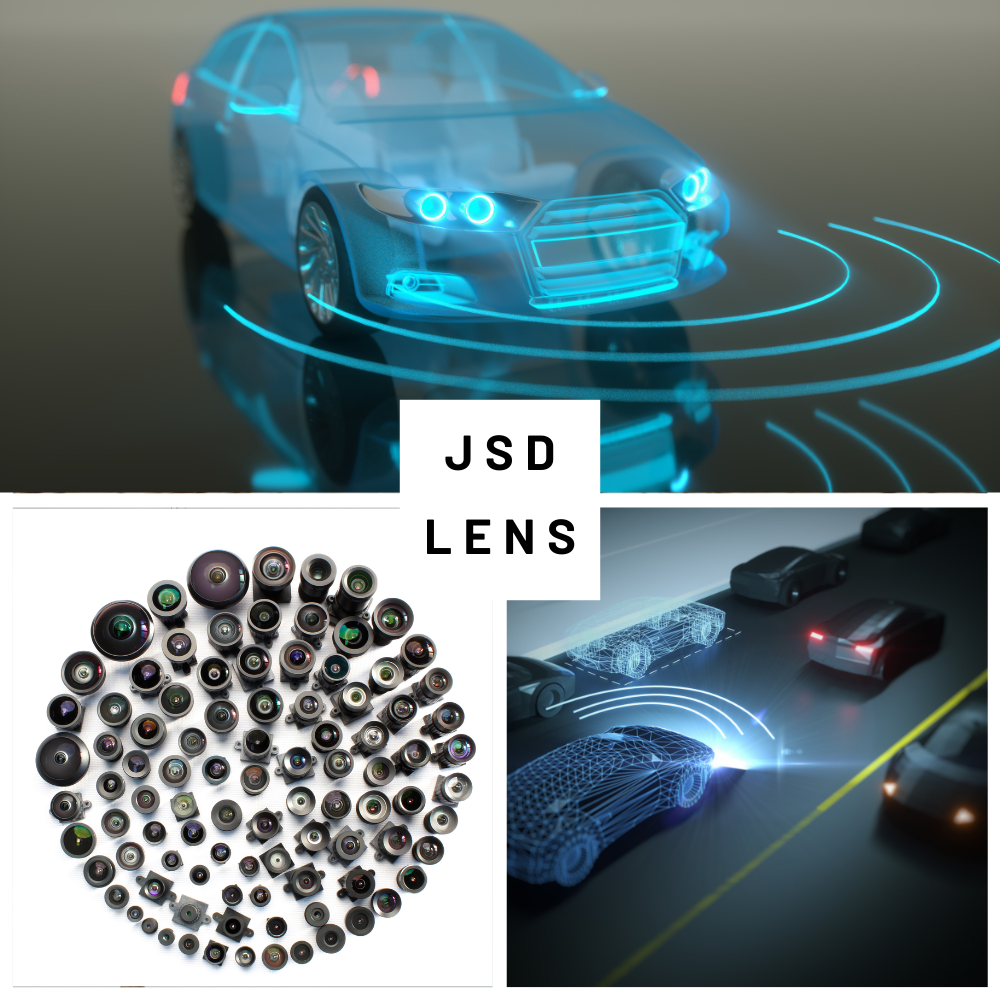
In the realm of autonomous driving, the lens is not merely a component; it is the origin of data. Through fully automated precision manufacturing, deep R&D heritage, and comprehensive scenario coverage, JSD defines the standard for "Automotive Grade" optics. Choosing JSD represents a commitment to the safety and reliability of intelligent driving systems.
 Consult now