Sony IMX307 Starlight Sensor: How F1.0 Ultra-Large Aperture Elevates Night Vision Performance
Achieving "Full-Color Night Vision" in ultra-low light environments is a core requirement for security surveillance, dash cams, and AIoT vision terminals. The Sony IMX307, a classic Starvis sensor, derives its primary value from its exceptional sensitivity. However, a high-performance sensor model is not enough; it must be paired with an F1.0 ultra-large aperture M12 Lens to truly break the limits of darkness.
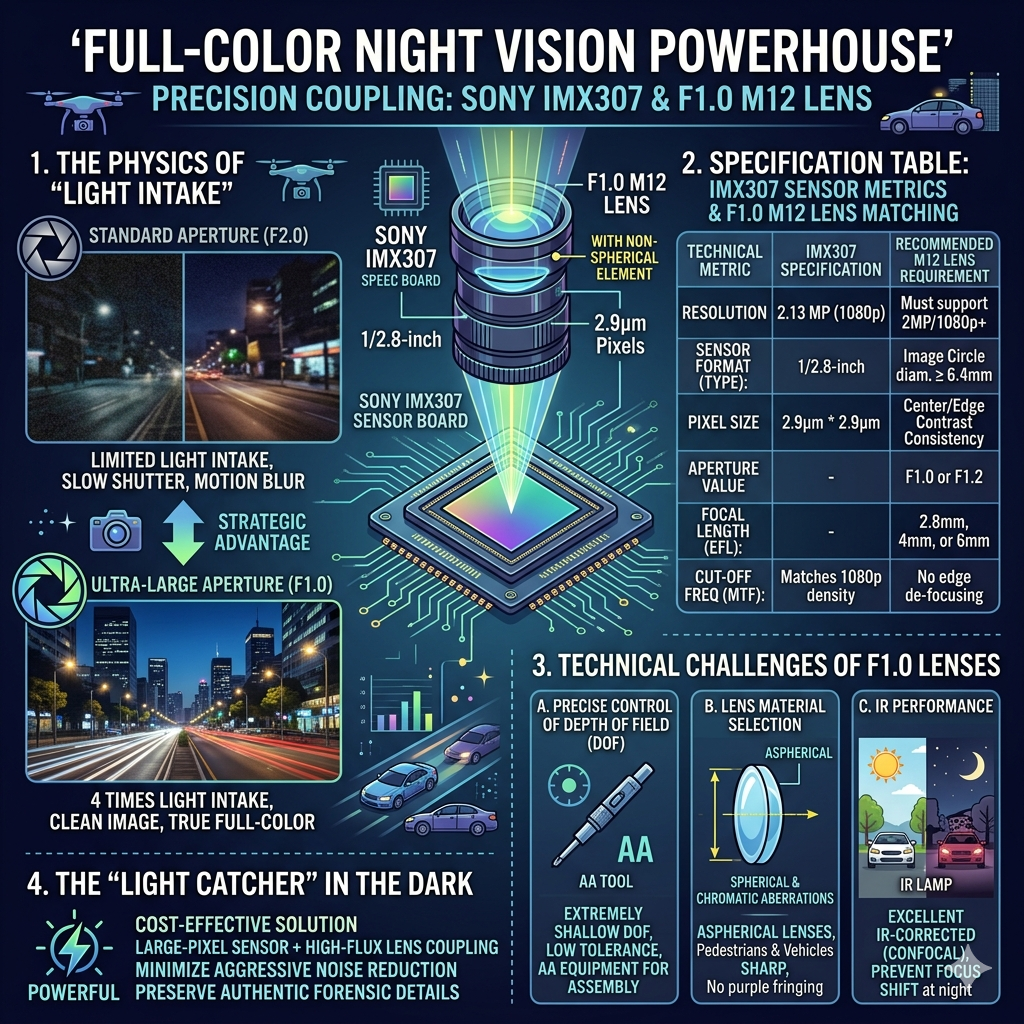
1. The Physics of "Light Intake": A Strategic Advantage
The IMX307 is a 1/2.8-inch sensor with a unit pixel size of 2.9μm * 2.9μm. This large pixel design provides the foundation for sensitivity. However, an optical system follows the "Leaky Bucket" principle: the volume of light intake (luminous flux) is primarily determined by the lens Aperture.
Standard Aperture (F2.0): Limited light intake causes the shutter speed to slow down in low light, resulting in severe motion blur and a surge in image noise.
Ultra-Large Aperture (F1.0): The light intake is 4 times that of an F2.0 lens. This allows the sensor to receive sufficient signal under faint light, maintaining a clean image without cranking up the Gain (ISO), thus achieving true full-color display.
2. Specification Table: IMX307 Sensor Metrics & F1.0 M12 Lens Matching
To achieve starlight-level imaging, the following technical parameters are required for precision matching:
Technical Metric | IMX307 Specification | Recommended M12 Lens Requirement |
Resolution | 2.13 MP (1920 * 1080) | Must support 2MP/1080p or higher |
Sensor Format (Type) | 1/2.8-inch | Image Circle diameter ≥ 6.4mm |
Pixel Size | 2.9μm * 2.9μm | Priority on contrast consistency between center and edge |
Aperture Value | - | F1.0 or F1.2 (Key to starlight performance) |
Focal Length (EFL) | - | Commonly 2.8mm, 4mm, or 6mm (based on FOV) |
Cut-off Freq (MTF) | Matches 1080p density | Ensure no edge de-focusing at ultra-large apertures |
3.Technical Challenges of F1.0 Lenses: Depth of Field and Aberration
When pairing an F1.0 M12 lens with the IMX307, developers must address specific implementation details:
Precise Control of Depth of Field (DOF): While an F1.0 aperture provides massive light intake, the trade-off is an extremely shallow DOF. The tolerance for focus adjustment is very low. It is recommended to use high-precision Active Alignment (AA) equipment during assembly to ensure the entire frame falls within the focal depth.
Lens Material Selection: Ultra-large apertures demand more light passage, which can lead to severe spherical and chromatic aberrations. High-quality F1.0 M12 lenses typically utilize Aspherical Lenses. This design effectively corrects aberrations, ensuring that pedestrians and vehicles under streetlights remain sharp without purple fringing.
IR Performance: Since the IMX307 is often used for 24/7 surveillance, the lens must feature excellent IR-Corrected (confocal) performance. Without IR correction, a lens focused during the day will experience a focus shift at night when the IR illuminator is activated.
4. The "Light Catcher" in the Dark
The combination of the Sony IMX307 and an F1.0 M12 Lens represents a highly cost-effective "Full-Color Night Vision" solution. By physically coupling a large-pixel sensor with a high-flux lens, developers can minimize the need for aggressive noise-reduction algorithms, preserving the most authentic details for forensic evidence.
Compatible Models
JSD2635 4.4mm M8 Lens - JSD OPTICAL LENS
 Consult now